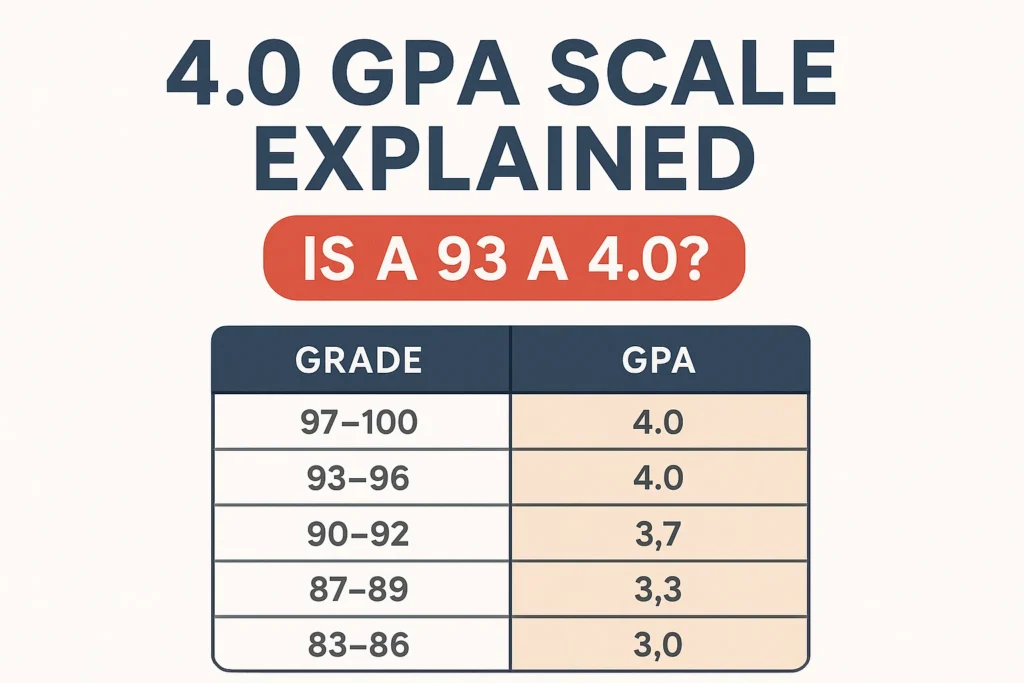
On the 4.0 GPA scale, each percentage grade matches a grade point value. A 93 usually counts as an A, which often equals a 4.0 GPA, though some schools may classify it as an A- worth around 3.7. Grading systems differ, so it’s important to check your school’s conversion chart.
This guide explains how the 4.0 scale works, what a 93 means in GPA terms, and provides a clear conversion chart to help you calculate your GPA accurately.
What is the 4.0 GPA Scale?
The 4.0 GPA scale is the most common unweighted GPA scale used in the United States to measure academic performance. It converts letter grades into numerical values that range from 0.0 to 4.0, allowing schools and colleges to assess student achievement in a clear and consistent way.
On the 4.0 grading scale, an A equals 4.0, a B equals 3.0, a C equals 2.0, a D equals 1.0, and an F equals 0.0. These values represent how well a student performs in each class and help calculate the overall grade point average.
Because it is an unweighted system, all courses carry the same value regardless of difficulty. An A in a standard class counts the same as an A in an advanced or honors class. This ensures a fair measure of performance based solely on grades earned.
A 4.0 GPA reflects perfect academic results and shows consistent excellence across all subjects. The simplicity of this scale makes it the foundation for most grading systems in high schools and colleges throughout the United States.
So, Is a 93 a 4.0 GPA?
A 93 percent GPA usually converts to a 4.0 on the unweighted scale because most schools classify a 93% as an A grade. On the 93 to 4.0 scale, this score represents excellent academic performance and shows consistent achievement in coursework.
However, the exact conversion can differ depending on the grading policy of each school or district. Some schools consider an A to begin at 90 percent, while others set the cutoff at 92 or 93 percent. This means that in some grading systems, a 93 is the minimum score needed to earn a 4.0 GPA, while in others it already falls within the top grade range.
Generally, grades between 90 and 100 percent fall within the A range and correspond to a 4.0 GPA. If a school uses a weighted grading system, advanced or honors classes may increase the GPA slightly above 4.0.
When students ask what is a 93 GPA, it typically means a perfect GPA on the unweighted scale. A 93% reflects strong academic performance and places a student among the highest achievers in most grading systems.
How to Calculate Your GPA on a 4.0 Scale
Learning how to calculate gpa on a 4.0 scale is simple once you understand the steps. The process uses a standard GPA formula that combines your course grades with their assigned credit hours. By converting letter grades into numbers, multiplying them, and dividing the totals, you can see your exact academic standing.
Step 1: Convert Letter Grades to GPA Points
Each letter grade has a specific grade point value. This letter grade conversion forms the base of your calculation. For example:
- A = 4.0
- A- = 3.7
- B+ = 3.3
- B = 3.0
- B- = 2.7
- C+ = 2.3
- C = 2.0
- D = 1.0
- F = 0.0
This scale ensures consistency, where an A equals 4.0 as the highest achievement.
Step 2: Calculate Your Quality Points
Next, find the quality points for each course. Multiply the grade point value by the number of credit hours. For example, a B (3.0) in a 4-credit class equals 12 quality points. This step is the foundation of accurate GPA calculation.
Step 3: Find Your Final GPA
Add together all the total quality points earned across your courses. Then divide this number by your total credit hours. This final step applies the GPA formula and shows your exact grade point average. You may also use a GPA calculator, but manual calculation helps you clearly understand the process.
4.0 GPA to Percentage Conversion Chart
Understanding how a GPA translates to percentages helps students compare grades across different systems. The grade conversion scale below shows how letter grades, percentages, and the 4.0 scale align in most schools. This percentage to GPA chart includes plus and minus variations for accuracy.
Letter Grade
Percentage Range
GPA
A+
97-100%
4.0
A
93-96%
4.0
A-
90-92%
3.7
B+
87-89%
3.3
B
83-86%
3.0
B-
80-82%
2.7
C+
77-79%
2.3
C
73-76%
2.0
C-
70-72%
1.7
D+
67-69%
1.3
D
65-66%
1.0
F
Below 65%
0.0
This GPA to percent guide provides a quick reference for students and parents. While schools may adjust ranges slightly, the chart gives a reliable overview of how classroom performance converts into GPA values. It helps when reviewing transcripts, applying to colleges, or comparing results across grading systems.
Weighted vs. Unweighted GPA: What’s the Difference?
When comparing GPAs, the most important distinction is between the unweighted GPA and the weighted GPA scale. Both measure academic performance, but they calculate achievement differently.
An unweighted GPA is the simplest method. It uses the standard 4.0 scale where an A equals 4.0, a B equals 3.0, and so on. All classes, whether regular or advanced, are valued the same. This system provides a straightforward picture of a student’s average but does not reflect the difficulty of courses taken.
A weighted GPA, by contrast, accounts for academic rigor. Many schools use a 5.0 scale for this purpose. Under the weighted GPA scale, advanced classes such as AP/IB class GPA or honors course GPA receive extra points. For example, earning an A in an AP class might be calculated as a 5.0 instead of a 4.0, while a B in the same course could count as a 4.0 instead of a 3.0. This system rewards students who challenge themselves with demanding coursework.
The key difference is that unweighted GPAs measure grades alone, while weighted GPAs reflect both grades and course difficulty. Understanding both systems helps students interpret their transcripts accurately and present their achievements fairly in college applications.
What Is Considered a “Good” GPA?
A “good” GPA depends on context, but certain benchmarks provide clear guidance. In high school, a 3.0 average GPA is often viewed as a solid starting point. It shows consistent performance and usually meets the minimum requirement for many colleges. However, competitive universities expect more.
For college admissions, a 3.5 GPA is widely considered strong. It signals above-average achievement and improves chances of acceptance into selective programs. Many scholarships also use this threshold when reviewing applicants. Going higher makes an even greater difference.
A 3.7 GPA or above is typically excellent. Students at this level often stand out for academic dedication and consistency. This range is competitive for top-tier universities, merit-based scholarships, and honors programs. It demonstrates mastery across a variety of subjects.
At the college level, maintaining a good GPA is just as important. A good college GPA varies by field of study, but a 3.0 usually keeps students in good academic standing. For graduate programs, professional schools, and competitive internships, a 3.5 or higher carries significant weight.