Many college students are confused when looking at their academic transcripts. One of the key factors in understanding your GPA is quality points. Universities use quality points to calculate your official Grade Point Average (GPA), but it’s not always clear how they work. This article will break down quality points and explain how they affect your GPA.
What Are Quality Points in College?
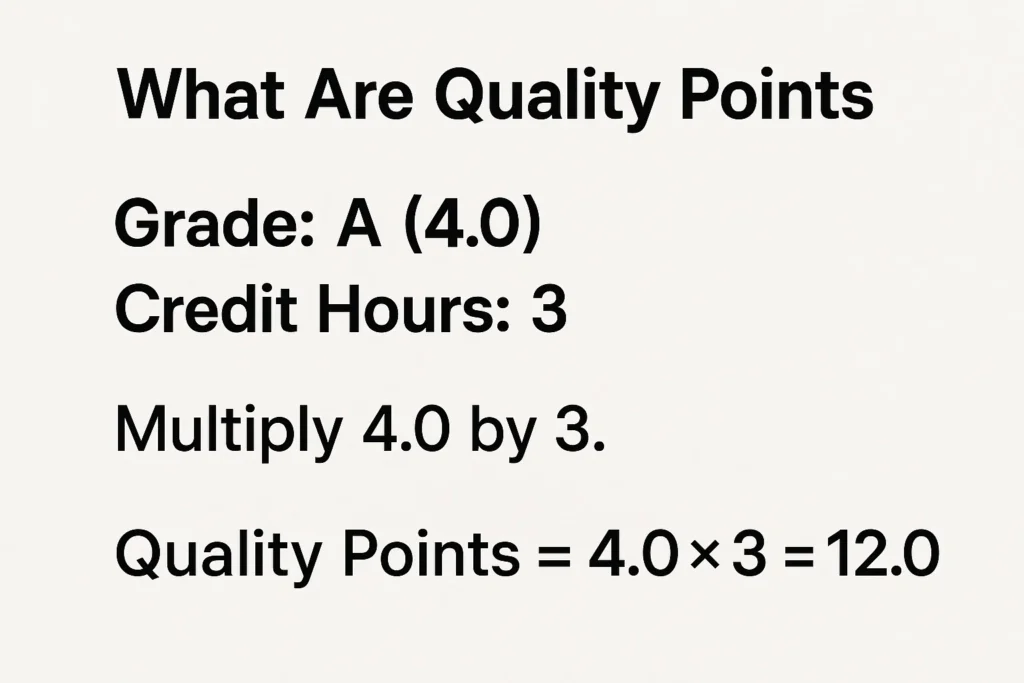
Quality points are numerical values that represent your performance in a college course. They are based on both your grade and the number of credit hours the course is worth. Each grade you receive is assigned a specific number of quality points, and these points are then multiplied by the course’s credit hours. This system helps calculate your GPA.
For example, if you earn an A in a 3-credit course, you will receive 4 quality points for that grade (since an A is typically worth 4 points). If you multiply this by the 3 credit hours, you would earn 12 quality points for the course.
Now, if you get an A in a 1-credit course, you’ll still earn 4 quality points for the grade, but since the course is worth fewer credit hours, you’ll only get 4 quality points in total. The more credit hours a course has, the greater its impact on your GPA.
Understanding what quality points mean is important because this system ensures that your GPA fairly reflects the difficulty and effort required for each course. By using quality points, universities can create a standardized way to assess academic performance, considering both the grade earned and the weight of the course.
How Are Quality Points Calculated From Your Grades?
To calculate your quality points for each class, use the following formula:
Quality Points = Grade’s Numerical Value x Course Credit Hours
Each letter grade has a specific numerical value, and this value is multiplied by the number of credit hours the course is worth. This gives you the quality points for that class. Here’s a table that shows the standard numerical values for common letter grades:
Letter Grade
Numerical Value
A
4.0
A-
3.7
B+
3.3
B
3.0
B-
2.7
C+
2.3
C
2.0
C-
1.7
D+
1.3
D
1.0
F
0.0
Impact of Plus (+) and Minus (-) Grades on Quality Points
Many schools use plus (+) and minus (-) signs to give more precise grades. These small changes can affect the quality points. For example:
- A- is worth 3.7, which is slightly lower than the full 4.0 for an A.
- B+ is worth 3.3, higher than a B (which is 3.0) but lower than an A-.
These small adjustments help better reflect students’ performances. Not all schools use this system, so it’s important to check how your school handles plus and minus grades.
Example Calculations
Let’s look at some examples of how to calculate quality points:
Example 1
- Grade: A (4.0)
- Credit Hours: 3
- Multiply 4.0 by 3.
- Quality Points = 4.0 x 3 = 12.0
Example 2
- Grade: B+ (3.3)
- Credit Hours: 4
- Multiply 3.3 by 4.
- Quality Points = 3.3 x 4 = 13.2
Example 3
- Grade: C (2.0)
- Credit Hours: 2
- Multiply 2.0 by 2.
- Quality Points = 2.0 x 2 = 4.0
After calculating the quality points for each class, you can track your overall performance. Using a quality points calculator makes this process easier, helping you understand how each class contributes to your GPA.
The Connection Between Quality Points and GPA
Now that you understand how quality points work, let’s see how they connect to your GPA. The term “quality point average” is the official name for what we call GPA. Your GPA equals all your quality points divided by your total credit hours.
Here’s how quality points gpa works: You add up all quality points from every course. Then you divide this total by your “GPA hours” – the total credit hours from all courses in your GPA calculation.
Credit hours make a big difference. A 4-credit course with a B grade (3.0 points) gives you 12 quality points. A 1-credit course with the same B grade gives you only 3 quality points. The 4-credit course affects your quality point average four times more.
This system is fair. Courses that need more time and effort should count more in your final GPA. A tough 4-credit chemistry class should impact your grades more than a 1-credit seminar.
Understanding gpa hours meaning helps you make strategic academic decisions. When you plan your semester, remember that higher credit courses will significantly affect your overall GPA – both positively if you perform well, or negatively if you struggle.
Credit Hours Impact Example
4-Credit Course
B Grade (3.0 points) × 4 credits
1-Credit Course
B Grade (3.0 points) × 1 credit
The 4-credit course affects your GPA four times more!
How to Calculate Your GPA Using Quality Points: Step-by-Step Guide
Learning how to calculate quality points gpa is essential for tracking your academic progress. You can calculate your GPA with two simple steps. First, add all quality points from your courses. Second, add all credit hours from those courses. Then divide quality points by credit hours to get your grade point average.
The Quality Points GPA Formula
GPA = Total Quality Points ÷ Total Credit Hours
Here’s a practical quality points calculator example with five courses to show you exactly how to calculate GPA:
Course
Grade
Grade Points
Credit Hours
Quality Points
Math 101
A
4.0
3
12.0
English 102
B+
3.3
3
9.9
Biology 150
B
3.0
4
12.0
History 201
A-
3.7
3
11.1
PE 100
A
4.0
1
4.0
TOTALS
–
–
14
49.0
Step 1: Add Quality Points
12.0 + 9.9 + 12.0 + 11.1 + 4.0 = 49.0 total quality points
Step 2: Add Credit Hours
3 + 3 + 4 + 3 + 1 = 14 total credit hours
Final Calculation
49.0 ÷ 14 = 3.5 GPA
This quality points calculator method works for calculating GPA in any semester. Simply use your actual grades and credit hours to determine your quality point average.
Notice how Biology (4 credits) affects your quality points gpa more than PE (1 credit)? Biology’s B grade contributes 12 quality points, while PE’s A grade adds only 4 points. Higher credit hours create bigger impact on your final grade point average.
You can calculate quality points by hand or use online GPA calculators to verify your results. Many students create simple spreadsheets to track their quality points gpa throughout each semester.
How to Calculate Cumulative GPA with Quality Points
Calculating your cumulative quality points gpa follows the same process but uses totals from all completed semesters. Add all quality points from every semester. Add all credit hours from every semester. Then divide total quality points by total credit hours to get your cumulative grade point average.
Here’s how to calculate cumulative quality points gpa using a student’s three-semester record:
Semester 1 (Fall 2023
45 quality points, 15 credit hours
Semester 2 (Spring 2024)
49 quality points, 14 credit hours
Semester 3 (Fall 2024)
52 quality points, 16 credit hours
Total quality points:
45 + 49 + 52 = 146
Total credit hours:
15 + 14 + 16 = 45
Cumulative GPA:
146 ÷ 45 = 3.24
Your cumulative quality points gpa represents your overall college academic performance. This grade point average appears on your official transcript and is what employers and graduate schools review when evaluating candidates.
In this example, the student’s individual semester GPAs were 3.0, 3.5, and 3.25, but their cumulative quality points gpa equals 3.24. This demonstrates how earlier semesters continue influencing your overall grade point average. As you accumulate more credit hours, it becomes increasingly difficult to dramatically change your cumulative GPA with just one semester’s performance.
Understanding quality points helps you start strong in your first year. Poor early grades require many excellent grades later to improve your cumulative quality point average.
Cumulative GPA Scale Guide
After you calculate your GPA with quality points, you need to know what your number means. This cumulative gpa scale guide shows you where you stand and what to do next.
Each GPA range means something different in college. When you know what is a good gpa, you can set better goals and understand what employers and schools think of your grades.
GPA Range
Academic Standing
Typical Meaning
Opportunities
3.7 – 4.0
Summa/Magna Cum Laude
Excellent academic performance
Top graduate programs, competitive scholarships, honor societies
3.3 – 3.69
Cum Laude / Dean’s List
Above average performance
Most graduate programs, good job prospects, academic recognition
3.0 – 3.29
Good Standing
Solid academic performance
Many graduate programs, standard job opportunities
2.5 – 2.99
Good Standing
Below average but acceptable
Some graduate programs, focus on improvement needed
2.0 – 2.49
Academic Warning
Minimum acceptable performance
Limited options, academic support recommended
Below 2.0
Academic Probation
Unsatisfactory performance
Risk of dismissal, immediate intervention required
What Is a Good GPA?
A “good” GPA depends on your future goals:
- 3.5+ is excellent for grad school and competitive careers.
- 3.0+ is solid for most jobs and many postgraduate programs.
- Below 3.0 can still work if you have strong skills, projects, or experience to show.
Important: This cumulative gpa scale guide gives general information, but every university has different rules. Your school’s requirements for honors, probation, and graduation may be very different from this college gpa scale.
Always check your student handbook or ask your academic advisor for your school’s exact GPA requirements. Some programs at your university may need higher GPAs than the general college gpa scale.
How to Read Quality Points on Your College Transcript
Now that you understand quality points calculations, you need to know where to find what are quality points on a transcript. Your official college transcript shows all the numbers we discussed, but many students don’t know where to look.
When you look at what are quality points on a college transcript, you’ll see several key columns. Most transcripts use abbreviations like “QHRS” for Quality Hours, “QPTS” for Quality Points, and “GPA” for your grade point average. These appear in both semester sections and your cumulative totals.
Example
Fall 2024 Semester
Course
Credits
Grade
QHRS
QPTS
MATH 101
3
A
3.0
12.0
ENG 102
3
B+
3.0
9.9
BIO 150
4
B
4.0
12.0
Semester Totals:
10
–
10.0
33.9
Semester GPA: 3.39
Cumulative Totals
Total QHRS:
45.0
Total QPTS:
146.7
Cumulative GPA:
3.26
Understanding Each Column
QHRS (Quality Hours)
This shows the credit hours that count toward your GPA. For most courses, this equals the credit hours. However, some courses like pass/fail classes may show 0 QHRS because they don’t affect your GPA calculation.
QPTS (Quality Points)
This column shows the actual quality points earned for each course. As we discussed earlier, this equals your grade points multiplied by credit hours. These numbers add up to determine your GPA.
Semester vs. Cumulative
Your transcript shows both semester totals and cumulative totals. Semester numbers reflect just that term’s performance, while cumulative numbers include all completed coursework from your entire college career.
Tip: When checking what are quality points on a college transcript, always compare both semester and cumulative rows one shows short-term performance, the other your full academic record.